Although one is fiction and the other nonfiction, both projects explore a common question: How should artificial intelligence shape human decisions, and where should humans remain firmly in control?
The Missing Variable
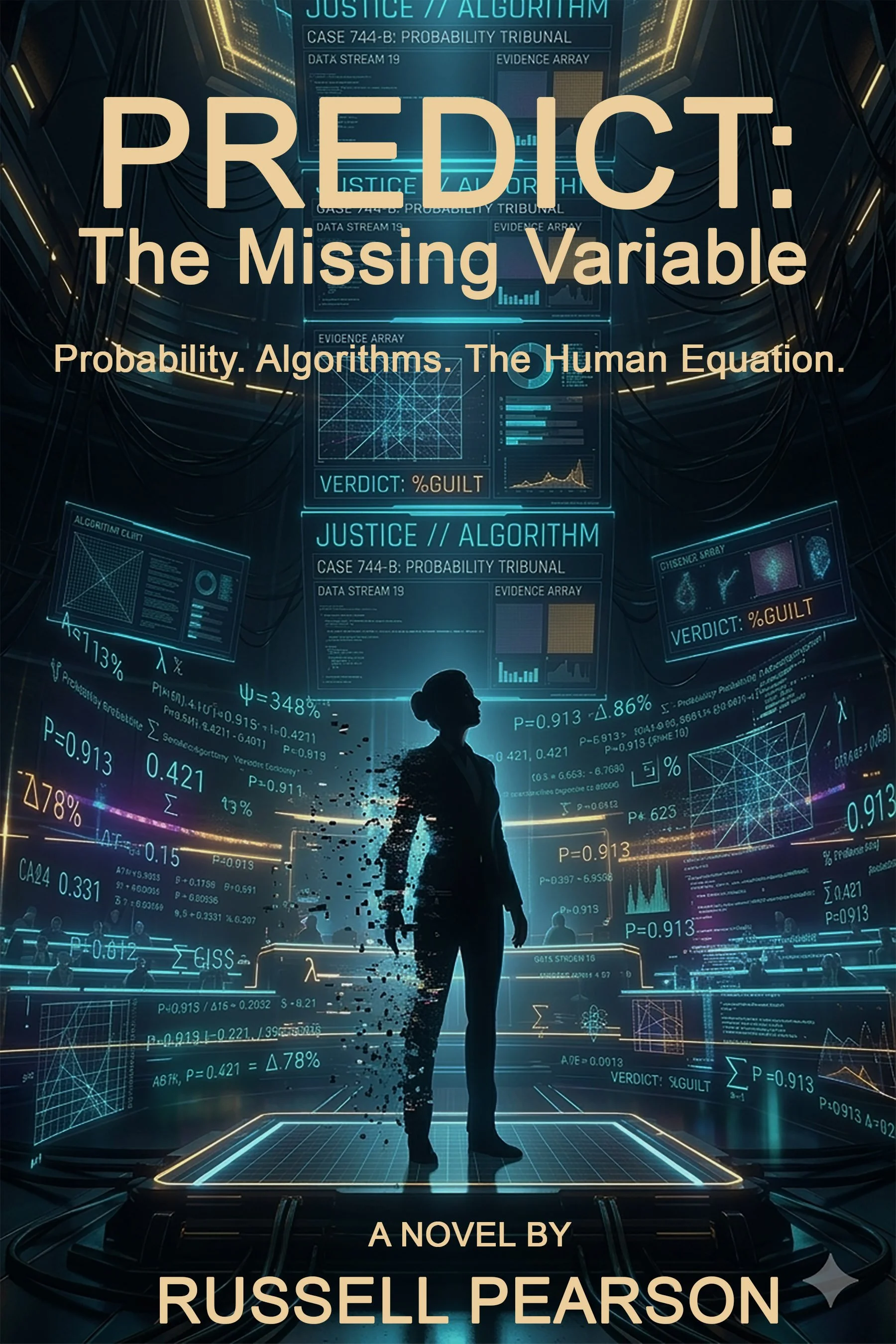
The Missing Variable is the first novel in The PREDICT Trilogy, a speculative thriller exploring a world where artificial intelligence is used to anticipate violent crime before it happens.
In this near-future society, the PREDICT system analyzes vast streams of behavioral data to determine who will commit murder before the act occurs. When the system identifies a future killer, intervention begins immediately. The process is presented as objective, data-driven, and nearly impossible to challenge.
But when the system issues a prediction that doesn’t make sense, the certainty behind predictive justice begins to unravel.
The Missing Variable introduces readers to the world of PREDICT and the people forced to confront the consequences of a system that claims it can know the future. As questions emerge about what the system sees—and what it might be missing—the story explores deeper issues about technology, accountability, and the limits of prediction.
This first installment in The PREDICT Trilogy sets the stage for a larger story about the relationship between artificial intelligence, justice, and human choice. Book Two PREDICT: The Cost of Certainty will come later this year.
Purchase the book from Amazon here. The Kindle, Paperback, and Hard cover edition can be found here: https://www.amazon.com/dp/B0H7YNV4D8
Paperback version can also be found at my InstaSpark Store. Only $13.99 currently. https://tinyurl.com/3hp368jd
Hardcover version can also be found at my InstaSpart Store. Only $20.99 currently, https://tinyurl.com/4mb88dxj
The Thinking We Can't Outsource in an AI World
Teaching, Learning, and Judgment in an Age of Artificial Intelligence
Artificial intelligence has sparked countless conversations in higher education. Questions about academic integrity, assessment, student engagement, faculty roles, and the future of learning seem to appear everywhere. New tools emerge almost weekly, and institutions are working to understand what these changes mean for teaching and learning.
But the more I engage in these conversations, the more I find myself returning to a different question.
What if the most important story isn't about AI?
What if it's about learning?
Many of the challenges we attribute to artificial intelligence are not entirely new. Students have always looked for efficient ways to complete tasks. Faculty have long debated how to measure learning. Questions about motivation, engagement, critical thinking, and assessment have existed for decades.
AI did not create these tensions. It exposed them. That realization became the starting point for this project.
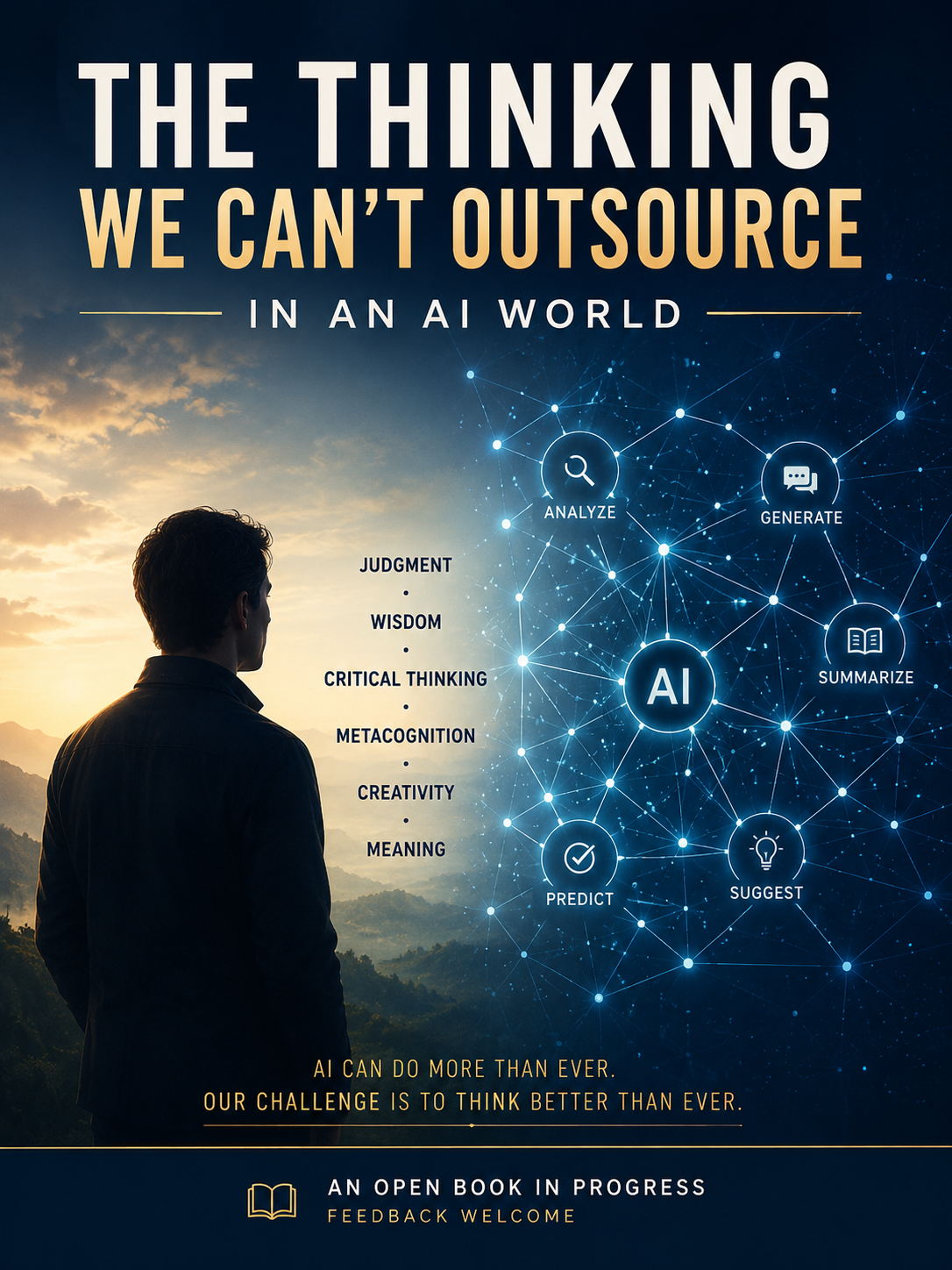
The Thinking We Can't Outsource in an AI World explores what artificial intelligence is revealing about teaching, learning, and judgment. Rather than focusing primarily on tools, prompts, or technology trends, this project examines a deeper question:
What kinds of thinking remain essential for students to do themselves in a world where increasingly powerful AI systems can generate answers, explanations, and content on demand?
The answer has implications far beyond AI.
It touches assessment.
Motivation.
Metacognition.
AI literacy.
Instructional design.
Faculty development.
And ultimately, our understanding of what learning is meant to accomplish.
Why This Project Is Different
Most books are written privately and released when the manuscript is complete. I'm taking a different approach. This is an open book project.
The ideas are being developed publicly through a combination of blog posts, expanded book sections, presentations, workshops, conversations with faculty, and ongoing reflection. As each section is completed, it will be shared here.
Some ideas will evolve. Some sections will be revised. New research, examples, and insights will be incorporated as the project grows. Rather than presenting a finished product from the start, this project makes the development process visible. In many ways, that approach reflects one of the book's central themes: learning is a process, not simply a product.
How the Project Is Organized
The book is being developed in major sections, each exploring a different aspect of teaching and learning in an AI-rich world. The first section examines what AI is revealing about learning, assessment, motivation, and the evolving role of faculty.
Future sections will explore practical instructional design strategies, AI literacy, cognitive science, agentic AI, and the future of higher education.
Each section builds on the one before it, creating a larger conversation about how education can evolve without losing sight of what matters most.
Join the Journey
I don't pretend to have all the answers. In many ways, higher education is still learning how to navigate this moment. My hope is that this project contributes to that conversation by focusing less on fear, hype, or technology itself and more on the human side of learning. Because while AI may change many aspects of education, I believe some things remain fundamentally important.
Judgment.
Reflection.
Purpose.
Self-awareness.
The ability to evaluate information and make sense of complexity.
The ability to understand not only what we think, but how we arrived there.
In other words, the thinking we can't outsource. Thank you for following along as this project develops.
This is a living draft that will continue to evolve as new chapters are written and feedback is received. Readers who choose to receive updates will be notified when significant new content becomes available. Request a free copy of the current version of the book here: https://tinyurl.com/3pvjp34m
Please feel free to provide feedback using this form: https://forms.gle/EohrAemESoz41UueA, it is appreciated.